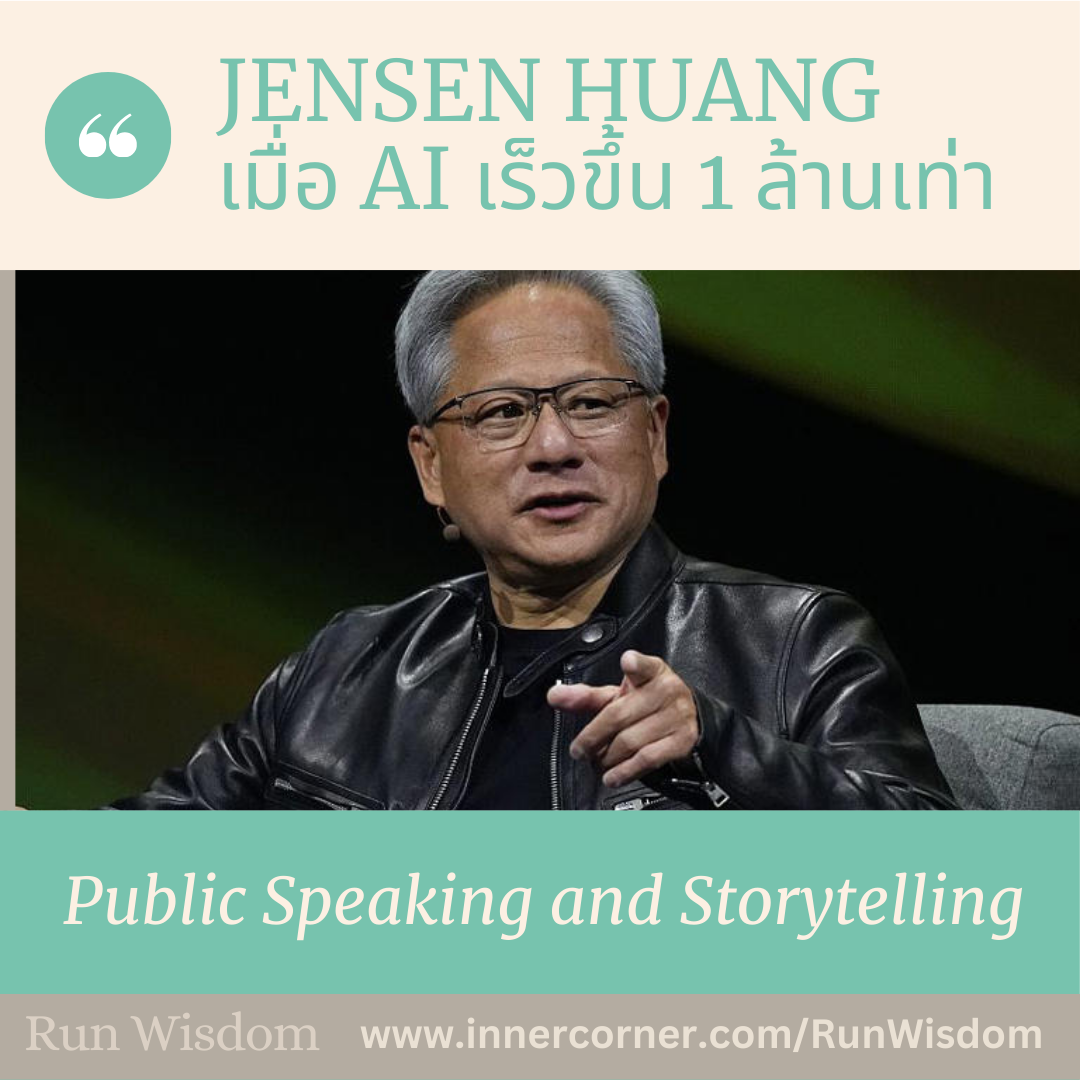
เรียนรู้เทคนิคการพูดและการเล่าเรื่องของ Jensen Huang
จากสุนทรพจน์และการให้สัมภาษณ์ของ Jensen Huang CEO ของ NVIDIA เราสามารถเรียนรู้เทคนิคการพูดในที่สาธารณะและการเล่าเรื่องที่น่าสนใจหลายประการ ซึ่งทำให้เขาสามารถอธิบายเรื่องราวที่ซับซ้อนของเทคโนโลยีให้เข้าใจง่ายและน่าติดตามได้อย่างยอดเยี่ยม
ถอดบทเรียนการเล่าเรื่องและพูดในที่สาธารณะสไตล์ Jensen Huang
Jensen Huang มีความสามารถโดดเด่นในการเปลี่ยนหัวข้อเทคโนโลยีที่ซับซ้อนให้กลายเป็นเรื่องราวการเดินทางที่น่าตื่นเต้นและมองเห็นภาพได้ชัดเจน เขาสามารถดึงผู้ฟังให้ติดตามประวัติศาสตร์ นวัตกรรม และวิสัยทัศน์ในอนาคตของ NVIDIA ได้อย่างน่าทึ่ง เทคนิคสำคัญที่สามารถเรียนรู้จากเขาได้ มีดังนี้
1. ใช้ภาพและการเล่าเรื่องแบบไทม์ไลน์เพื่อสร้างความเข้าใจ
แทนที่จะเริ่มต้นด้วยข้อมูลทางเทคนิคที่ซับซ้อน Huang เลือกที่จะนำเสนอการเดินทางของ NVIDIA ผ่าน "การ์ตูน" ที่เขาสั่งทำขึ้น. วิธีนี้ช่วยลดความซับซ้อนของข้อมูลและทำให้ผู้ฟังเห็นภาพรวมของการพัฒนาที่สำคัญในอุตสาหกรรมคอมพิวเตอร์ ตั้งแต่ IBM System 360, การก่อตั้ง NVIDIA ในปี 1993, การเผชิญหน้ากับ AI ครั้งแรกในปี 2012 จนถึงยุคของ ChatGPT. การเล่าเรื่องตามลำดับเวลาทำให้ผู้ฟังเข้าใจบริบทและเห็นความสำคัญของแต่ละเหตุการณ์ได้ง่ายขึ้น
ตัวอย่าง: “I made a cartoon for you of our journey… these are some of the most important moments in the computer industry… in 1993 Nvidia was founded…”
2. เชื่อมโยงการตัดสินใจในอดีตกับความสำเร็จในปัจจุบัน
Huang เก่งในการอธิบายว่าการตัดสินใจเชิงกลยุทธ์ในอดีตส่งผลต่อความสำเร็จของบริษัทในปัจจุบันอย่างไร เขาเล่าว่าการเลือกที่จะมุ่งเน้นไปที่ "Computer Graphics" สำหรับวิดีโอเกม ซึ่งเป็นตลาดที่ต้องการพลังการประมวลผลสูงและมีปริมาณผู้ใช้มหาศาล เป็นหนึ่งในการตัดสินใจที่ดีที่สุด. สิ่งนี้สร้าง "Flywheel" หรือวงจรที่ขับเคลื่อนงบประมาณ R&D ของบริษัท และนำไปสู่การพัฒนาที่จำเป็นสำหรับยุค AI ในที่สุด การเล่าเรื่องแบบนี้แสดงให้เห็นถึงวิสัยทัศน์ที่ยาวไกลและความเฉียบแหลมในการวางกลยุทธ์
ตัวอย่าง: “…it was probably one of the best decisions we ever made because computer Graphics was insanely computationally intensive… The combination of very large volume, very complicated Computing problem led to a very large R&D budget for us which drove the flywheel of our company.”
3. เล่าเบื้องหลังนวัตกรรมสำคัญด้วยเรื่องราวที่เป็นรูปธรรม
เมื่อพูดถึงนวัตกรรมสำคัญอย่าง DLSS (Deep Learning Super Sampling) Huang ไม่ได้อธิบายแค่หลักการทำงาน แต่เล่าถึง "ปัญหา" ที่ทีมต้องเผชิญก่อน นั่นคือการทำ Real-time Ray Tracing ยังไม่เร็วพอสำหรับวิดีโอเกม. จากนั้นเขาจึงอธิบายว่า AI เข้ามาแก้ปัญหานี้ได้อย่างไร โดยการ "สอน AI ให้เติมจุดที่เหลือ" (fills in the dots). การเล่าเรื่องแบบ "ปัญหา-สู่-ทางออก" พร้อมใช้คำอธิบายที่เห็นภาพ ทำให้ผู้ฟังเข้าใจคุณค่าและความสำคัญของเทคโนโลยีนั้นๆ ได้อย่างลึกซึ้ง
ตัวอย่าง: “…we realized that we needed a big boost… and the team invented dlss which basically renders one pixel while it uses AI to infer a whole bunch of other pixels…”
4. ใช้โครงสร้างการอธิบายแบบ 3 ส่วนเพื่อทำให้เรื่องซับซ้อนง่ายขึ้น
ในการอธิบายว่า Generative AI จะสามารถควบคุมได้ดีขึ้นและแม่นยำขึ้นได้อย่างไร Huang ได้แบ่งแนวทางการพัฒนาออกเป็น 3 ประเด็นอย่างชัดเจน ได้แก่ 1) Guard railing (การกำหนดขอบเขต), 2) Retrieval Augmented Generation (การดึงข้อมูลที่น่าเชื่อถือมาเสริม), และ 3) Reinforcement Learning Human Feedback (การใช้มนุษย์ช่วยปรับแต่ง). การจัดลำดับความคิดและนำเสนอเป็นข้อๆ แบบนี้ ช่วยให้ผู้ฟังสามารถติดตามและทำความเข้าใจแนวคิดที่ซับซ้อนได้อย่างเป็นระบบ
ตัวอย่าง: “Guard railing which causes the AI to focus its energy… The third breakthrough is called retrieval augmented generation… these three combinations really made it possible for us to do that with text.”
5. สร้างวลีที่น่าจดจำเพื่อสรุปแนวคิดที่ซับซ้อน
เมื่อพูดถึงประเด็นเรื่องพลังงานสำหรับศูนย์ข้อมูล (Data Center) Huang ได้นำเสนอแนวคิดที่น่าสนใจว่าในอนาคตศูนย์ข้อมูลไม่จำเป็นต้องตั้งอยู่ใกล้แหล่งชุมชน แต่สามารถย้ายไปตั้งในที่ที่มีพลังงานเหลือใช้ได้ เขาสรุปแนวคิดนี้ด้วยประโยคที่สั้น กระชับ และน่าจดจำว่า "AI ไม่สนใจหรอกว่ามันจะไปเรียนที่ไหน". การใช้วลีคมคายเช่นนี้ช่วยให้สารที่ต้องการจะสื่อทรงพลังและติดอยู่ในใจของผู้ฟังได้นาน
ตัวอย่าง: “AI doesn't care where it goes to school… you're going to see data centers being built in different parts of the world where there's excess energy.”
โดยสรุป Jensen Huang ใช้ศิลปะการเล่าเรื่องที่ผสมผสานการใช้ภาพ การเล่าเรื่องราวตามลำดับเวลา การเชื่อมโยงเหตุและผล และการสรุปแนวคิดที่ซับซ้อนให้เป็นวลีที่น่าจดจำ ทำให้เขาสามารถสื่อสารวิสัยทัศน์และนวัตกรรมทางเทคโนโลยีที่ล้ำสมัยของ NVIDIA ให้กับผู้ฟังในวงกว้างได้อย่างมีประสิทธิภาพและน่าติดตาม
เนื้อหาทั้งหมดจากการให้สัมภาษณ์ในครั้งนี้
Jensen Huang: …we've accelerated deep learning by a million times which is the reason why it's now possible for us to create these large language models. A million times speed up a million times reduction in cost and energy is what made it possible for us to make General generative AI possible. And so I made a cartoon for you. I made a cartoon for you of our journey.
Interviewer: Did you make it or did Generative AI?
Jensen Huang: I had it made. I had it made. That's what CEOs do. We don't do anything we just have it be done. And so this is this cartoon here is really terrific. So these are some of the most important moments in the computer industry. The IBM System 360 of course the invention of modern Computing. The teapot 1975 the Utah teapot. 1979 Ray tracing. 1986 programmable shading of course most of the animated movies that we see today wouldn't be possible if not for programmable shading originally done on the Cray supercomputer. And then in 1993 Nvidia was founded. Chris Curtis and I founded the company. 1995 Windows PC revolutionized the personal computer industry put a personal computer in every home and every desk.
Jensen Huang: ...เราได้เร่งความเร็ว Deep Learning ขึ้นหนึ่งล้านเท่า ซึ่งเป็นเหตุผลว่าทำไมตอนนี้เราจึงสามารถสร้างโมเดลภาษาขนาดใหญ่เหล่านี้ได้ การเพิ่มความเร็วขึ้นหนึ่งล้านเท่า การลดต้นทุนและพลังงานลงหนึ่งล้านเท่า คือสิ่งที่ทำให้ Generative AI เกิดขึ้นได้ และดังนั้นผมจึงทำการ์ตูนมาให้คุณดู ผมทำการ์ตูนเกี่ยวกับการเดินทางของเรามาให้คุณ
ผู้สัมภาษณ์: คุณทำเองหรือให้ Generative AI ทำครับ?
Jensen Huang: ผมให้คนอื่นทำให้ครับ ผมให้คนอื่นทำให้ นั่นคือสิ่งที่ CEO ทำ เราไม่ได้ทำอะไรเลย เราแค่ให้มันสำเร็จ และการ์ตูนชิ้นนี้ยอดเยี่ยมมาก นี่คือช่วงเวลาที่สำคัญที่สุดบางส่วนในอุตสาหกรรมคอมพิวเตอร์ IBM System 360 แน่นอนว่าคือการประดิษฐ์คอมพิวเตอร์สมัยใหม่ กาน้ำชาปี 1975 หรือ Utah teapot ปี 1979 คือ Ray tracing ปี 1986 คือ Programmable shading ซึ่งแน่นอนว่าภาพยนตร์แอนิเมชันส่วนใหญ่ที่เราเห็นในปัจจุบันคงเป็นไปไม่ได้หากไม่มี Programmable shading ซึ่งเดิมทำบนซูเปอร์คอมพิวเตอร์ Cray และจากนั้นในปี 1993 NVIDIA ก็ได้ก่อตั้งขึ้น คริส เคอร์ติส และผมได้ร่วมกันก่อตั้งบริษัท ปี 1995 Windows PC ได้ปฏิวัติอุตสาหกรรมคอมพิวเตอร์ส่วนบุคคล ทำให้มีคอมพิวเตอร์ส่วนบุคคลในทุกบ้านและทุกโต๊ะทำงาน
Jensen Huang: 2001 we invented the first programmable shading GPU and that that really drove vast majority of nvidia's Journey up to that point. But at the background of everything we were doing was accelerated Computing so that you can solve problems that normal computers can't. And the application we chose first was computer graphics and it was probably one of the best decisions we ever made because computer Graphics was insanely computationally intensive and remain so for the entire 31 years that mvidia has been here. It was also incredibly high volume because we applied computer Graphics to an application at the time that wasn't mainstream 3D Graphics video games. The combination of very large volume very complicated Computing problem led to a very large R&D budget for us which drove the flywheel of our company.
Jensen Huang: ปี 2001 เราได้ประดิษฐ์ GPU ที่สามารถตั้งโปรแกรม Shading ได้เป็นครั้งแรก และนั่นคือสิ่งที่ขับเคลื่อนการเดินทางส่วนใหญ่ของ NVIDIA มาจนถึงจุดนั้น แต่เบื้องหลังของทุกสิ่งที่เราทำคือ Accelerated Computing (การประมวลผลแบบเร่งความเร็ว) เพื่อให้คุณสามารถแก้ปัญหาที่คอมพิวเตอร์ทั่วไปทำไม่ได้ และแอปพลิเคชันแรกที่เราเลือกคือคอมพิวเตอร์กราฟิก และนั่นอาจเป็นการตัดสินใจที่ดีที่สุดครั้งหนึ่งที่เราเคยทำมา เพราะคอมพิวเตอร์กราฟิกนั้นต้องใช้พลังการประมวลผลสูงอย่างบ้าคลั่ง และยังคงเป็นเช่นนั้นตลอด 31 ปีที่ NVIDIA อยู่ที่นี่ นอกจากนี้มันยังมีปริมาณมหาศาล เพราะเรานำคอมพิวเตอร์กราฟิกไปใช้กับแอปพลิเคชันที่ในขณะนั้นยังไม่เป็นที่นิยม นั่นคือวิดีโอเกมกราฟิก 3 มิติ การผสมผสานระหว่างปริมาณที่มหาศาลกับปัญหาการคำนวณที่ซับซ้อนอย่างยิ่ง ได้นำไปสู่งบประมาณด้านการวิจัยและพัฒนาจำนวนมากสำหรับเรา ซึ่งเป็นตัวขับเคลื่อนวงจรธุรกิจ (Flywheel) ของบริษัทเรา
Jensen Huang: One day in 2012 we made our first Contact you know Star Trek first Contact with artificial intelligence. That first Contact was alexnet and was in 2012 very big moment. We made the observation that alexnet was an incredible breakthrough in computer vision but at the core of it that it was a new way of writing software. Instead of Engineers given input imagining what the output was going to be WR algorithms we now have a computer that give an input an example outputs would figure out what the program is in the middle. That observation and that we can use this technique to solve a whole bunch of problems that previously wasn't solvable was a great observation and we changed everything in our company to pursue it from the processor to the systems to the the software stack all the algorithms Nvidia basic research pivoted towards working on deep learning.
Jensen Huang: วันหนึ่งในปี 2012 เราได้พบกับปัญญาประดิษฐ์เป็นครั้งแรก เหมือนในหนัง Star Trek: First Contact เลย การพบกันครั้งแรกนั้นคือ AlexNet ในปี 2012 ซึ่งเป็นช่วงเวลาที่ยิ่งใหญ่มาก เราสังเกตเห็นว่า AlexNet เป็นความก้าวหน้าอย่างไม่น่าเชื่อในด้านคอมพิวเตอร์วิทัศน์ (Computer Vision) แต่หัวใจของมันคือวิธีการเขียนซอฟต์แวร์แบบใหม่ แทนที่วิศวกรจะป้อนข้อมูลเข้าแล้วจินตนาการว่าผลลัพธ์จะเป็นอย่างไรเพื่อเขียนอัลกอริทึม ตอนนี้เรามีคอมพิวเตอร์ที่เมื่อให้ข้อมูลเข้าและตัวอย่างผลลัพธ์ มันจะคิดหาโปรแกรมที่อยู่ตรงกลางได้เอง การสังเกตนั้น และการที่เราสามารถใช้เทคนิคนี้เพื่อแก้ปัญหามากมายที่ไม่เคยแก้ไขได้มาก่อน ถือเป็นการสังเกตที่ยอดเยี่ยม และเราได้เปลี่ยนแปลงทุกอย่างในบริษัทของเราเพื่อมุ่งไปในทิศทางนั้น ตั้งแต่โปรเซสเซอร์ ระบบ ไปจนถึงชุดซอฟต์แวร์และอัลกอริทึมทั้งหมด งานวิจัยพื้นฐานของ NVIDIA ได้เปลี่ยนทิศทางมาทำงานด้าน Deep Learning
Jensen Huang: And so in 2016 we introduced the first computer we built for deep learning and we called it djx1. And I delivered the first djx1 outside of our company I built it for NVIDIA to build models for self-driving cars and Robotics and such and and generative AI for graphics. Somebody saw an example of djx1 Elon reached out to me and said hey I would love to have one of those for a startup company we starting. And so I delivered the first one to a company at the time that knew nobody knew about called open Ai and so that was 2016. 2017 was the Transformer that revolutionized modern machine learning modern deep learning. In 2018 right here at sigraph we announced RTX the world's first realtime interactive rate Tracer R tracing platform we call it RTX. It was such a big deal that we changed the name of GTX which everybody referred to our graphics cards as to RTX.
Jensen Huang: และในปี 2016 เราได้เปิดตัวคอมพิวเตอร์เครื่องแรกที่เราสร้างขึ้นสำหรับ Deep Learning และเราเรียกมันว่า DGX-1 และผมได้ส่งมอบ DGX-1 เครื่องแรกนอกบริษัทของเรา ผมสร้างมันขึ้นมาเพื่อให้ NVIDIA สร้างโมเดลสำหรับรถยนต์ไร้คนขับ หุ่นยนต์ และ Generative AI สำหรับงานกราฟิก มีคนเห็นตัวอย่างของ DGX-1 อีลอน (Elon) ติดต่อมาหาผมและบอกว่า "เฮ้ ผมอยากได้สักเครื่องสำหรับบริษัทสตาร์ทอัพที่เรากำลังจะเริ่ม" ดังนั้นผมจึงส่งมอบเครื่องแรกให้กับบริษัทที่ในตอนนั้นยังไม่มีใครรู้จักชื่อว่า OpenAI และนั่นคือปี 2016 ปี 2017 คือ Transformer ซึ่งปฏิวัติการเรียนรู้ของเครื่องจักรสมัยใหม่และ Deep Learning สมัยใหม่ ในปี 2018 ที่งาน SIGGRAPH แห่งนี้ เราได้ประกาศเปิดตัว RTX แพลตฟอร์ม Ray Tracing แบบอินเทอร์แอคทีฟเรียลไทม์เครื่องแรกของโลก เราเรียกมันว่า RTX มันเป็นเรื่องใหญ่มากจนเราเปลี่ยนชื่อ GTX ซึ่งทุกคนใช้เรียกการ์ดจอของเรา มาเป็น RTX
Interviewer: And you mentioned last year during your sigraph keynote that RTX rate tracing extreme was one of the big important moments when computer Graphics met AI.
Jensen Huang: That's right but that had been happening for a while actually. So what was so important about RTX in 2018 we made it possible to use a parallel processor to accelerate rate tracing. Um but even then we were rate tracing at about five frames every second depending on on how many Rays we're talking about tracing and we were doing it at 1080 resolution. Obviously video games need a lot more than that obviously realtime Graphics need more than that.
Interviewer: This crowd definitely knows what that means but for the folks who are watching online the rendering processes used to take a really long time when you were making something it used to take a Cray supercomputer to render just a few pixels and now we have our RTX to accelerate that rate tracing.
ผู้สัมภาษณ์: และคุณได้กล่าวไว้เมื่อปีที่แล้วในงาน SIGGRAPH ว่า RTX Ray Tracing Extreme เป็นหนึ่งในช่วงเวลาที่สำคัญมากที่คอมพิวเตอร์กราฟิกได้มาพบกับ AI
Jensen Huang: ถูกต้องครับ แต่มันเกิดขึ้นมาระยะหนึ่งแล้ว สิ่งที่สำคัญมากเกี่ยวกับ RTX ในปี 2018 คือเราทำให้สามารถใช้โปรเซสเซอร์แบบขนานเพื่อเร่งความเร็ว Ray Tracing ได้ แต่ถึงกระนั้น เราก็ทำ Ray Tracing ได้ที่ประมาณห้าเฟรมต่อวินาที ขึ้นอยู่กับจำนวนรังสีที่เรากำลังติดตาม และเราทำมันที่ความละเอียด 1080p แน่นอนว่าวิดีโอเกมต้องการความเร็วมากกว่านั้นมาก และกราฟิกแบบเรียลไทม์ก็ต้องการมากกว่านั้น
ผู้สัมภาษณ์: คนในงานนี้รู้ดีว่ามันหมายความว่าอะไร แต่สำหรับคนที่ดูออนไลน์อยู่ กระบวนการเรนเดอร์เคยใช้เวลานานมาก เวลาที่คุณสร้างอะไรบางอย่าง มันเคยต้องใช้ซูเปอร์คอมพิวเตอร์ Cray เพื่อเรนเดอร์เพียงไม่กี่พิกเซล และตอนนี้เรามี RTX เพื่อเร่งความเร็ว Ray Tracing นั้นแล้ว
Jensen Huang: It was interactive it was time but it wasn't fast enough to be a video game. And so we realized that we needed a big boost probably something along the lines of 20x or so maybe 50x or so boost and the team invented dlss which basically renders one pixel while it uses AI to infer a whole bunch of other pixels. And so we basically taught an AI that is conditioned on what it saw and then fills in the dots for everything else and now we're able to render fully rate Traced fully path Traced simulations at 4K resolution at 300 frames per second made possible by by Ai and so 2018 came along 2022 as we all know chat GPT came out fastest growing service in history. Just about every industry is going to be affected by this whether it's scientific Computing trying to do a better job predicting the weather with a lot less energy and very importantly robotics self-driving cars are all going to be transformed by generative AI.
Jensen Huang: มันเป็นแบบอินเทอร์แอคทีฟ มันเป็นเรียลไทม์ แต่มันยังไม่เร็วพอที่จะเป็นวิดีโอเกม ดังนั้นเราจึงตระหนักว่าเราต้องการการเพิ่มประสิทธิภาพครั้งใหญ่ อาจจะประมาณ 20 เท่า หรือ 50 เท่า และทีมก็ได้คิดค้น DLSS ขึ้นมา ซึ่งโดยพื้นฐานแล้วมันจะเรนเดอร์หนึ่งพิกเซลในขณะที่ใช้ AI เพื่ออนุมานพิกเซลอื่นๆ อีกเป็นจำนวนมาก ดังนั้นโดยพื้นฐานแล้วเราสอน AI จากสิ่งที่มันเห็น แล้วให้มันเติมจุดที่เหลือให้สมบูรณ์ และตอนนี้เราสามารถเรนเดอร์การจำลองแบบ Ray Tracing และ Path Tracing เต็มรูปแบบที่ความละเอียด 4K ได้ที่ 300 เฟรมต่อวินาที ซึ่งเป็นไปได้ด้วย AI และแล้วปี 2018 ก็มาถึง ปี 2022 อย่างที่เรารู้กัน ChatGPT ก็เปิดตัว เป็นบริการที่เติบโตเร็วที่สุดในประวัติศาสตร์ แทบทุกอุตสาหกรรมจะได้รับผลกระทบจากสิ่งนี้ ไม่ว่าจะเป็นการคำนวณทางวิทยาศาสตร์ที่พยายามพยากรณ์อากาศได้ดีขึ้นโดยใช้พลังงานน้อยลง และที่สำคัญมากคือหุ่นยนต์และรถยนต์ไร้คนขับ ทั้งหมดจะถูกเปลี่ยนแปลงโดย Generative AI
Interviewer: I've gotten the sense from talking to you recently that you are optimistic that this these generative AI tools will become more controllable more accurate. We all know that there are issues with hallucinations low quality outputs that people are using these tools and they're maybe not getting exactly the output that they're hoping for. Meanwhile they're using a lot of energy which which we're going to talk about why are you so optimistic about this what is what do you think is pointing Us in the direction of this generative AI actually becoming that much more useful and controllable.
ผู้สัมภาษณ์: จากการพูดคุยกับคุณเมื่อเร็วๆ นี้ ผมรู้สึกว่าคุณมองโลกในแง่ดีว่าเครื่องมือ Generative AI เหล่านี้จะสามารถควบคุมได้มากขึ้นและแม่นยำขึ้น เราทุกคนรู้ดีว่ายังมีปัญหาเรื่องการสร้างข้อมูลที่ผิดพลาด (Hallucinations) และผลลัพธ์คุณภาพต่ำ ซึ่งเมื่อผู้คนใช้เครื่องมือเหล่านี้แล้วอาจไม่ได้ผลลัพธ์ตามที่คาดหวังไว้ ในขณะเดียวกันมันก็ใช้พลังงานจำนวนมาก ซึ่งเราจะพูดถึงเรื่องนี้กัน ทำไมคุณถึงมองโลกในแง่ดีเกี่ยวกับเรื่องนี้ อะไรที่ทำให้คุณคิดว่า Generative AI กำลังจะกลายเป็นสิ่งที่มีประโยชน์และควบคุมได้มากขึ้น
Jensen Huang: The big breakthrough of Chad GPT was reinforcement learning human feedback which was the way of using humans to align the AI on our core values or align our AI on the skills that we would like it to perform. Other breakthroughs have arrived since then. Guard railing which causes the AI to focus its energy or Focus its response in a particular domain so that it doesn't wander off and pontificate about all kinds of stuff that you ask it about it would only focus on the things that it's been trained to do align to perform and it has deep knowledge in. The third breakthrough is called retrieval augmented generation which basically is data that has been embedded so that we understand the meaning of that data and so it's a more authoritative data set it goes beyond just the trained data set for example it might be all of the articles that you've ever written all of the papers that you've ever written and it could be essentially a a chatbot of you.
Jensen Huang: ความก้าวหน้าครั้งสำคัญของ ChatGPT คือ Reinforcement Learning Human Feedback (การเรียนรู้เสริมแรงจากผลตอบรับของมนุษย์) ซึ่งเป็นวิธีการใช้มนุษย์เพื่อปรับ AI ให้สอดคล้องกับค่านิยมหลักของเรา หรือปรับ AI ให้มีทักษะตามที่เราต้องการ หลังจากนั้นก็มีความก้าวหน้าอื่นๆ ตามมา อย่างเช่น Guard railing (การกำหนดขอบเขต) ซึ่งทำให้ AI มุ่งเน้นพลังงานหรือการตอบสนองในขอบเขตที่กำหนด เพื่อไม่ให้มันตอบนอกเรื่องหรือพูดถึงเรื่องต่างๆ ที่คุณถาม มันจะมุ่งเน้นเฉพาะสิ่งที่มันถูกฝึกมาให้ทำและมีความรู้ลึกซึ้งในเรื่องนั้นๆ ความก้าวหน้าประการที่สามเรียกว่า Retrieval Augmented Generation (การสร้างเสริมด้วยการดึงข้อมูล) ซึ่งโดยพื้นฐานคือข้อมูลที่ถูกฝังไว้เพื่อให้เราเข้าใจความหมายของข้อมูลนั้น ทำให้เป็นชุดข้อมูลที่น่าเชื่อถือมากขึ้น มันไปไกลกว่าแค่ชุดข้อมูลที่ใช้ฝึก เช่น อาจจะเป็นบทความทั้งหมดที่คุณเคยเขียน เอกสารทั้งหมดที่คุณเคยเขียน และมันสามารถกลายเป็นแชทบอทของคุณได้เลย
Jensen Huang: So everything that I've ever written or ever said could be vectorized and then created into a semantic database and then before an AI responds it would search the appropriate content from that Vector database and then augment it in its gener generative process.
Interviewer: And you think that is one of the most important factors.
Jensen Huang: These three combinations really made it possible for us to do that with text. Now the thing that's really cool is that we are now starting to figure out how to do that with visual. And so if you look at today's generative AI in this particular case this is a edify model that Nvidia created it's a 2d text to 2D Foundation model it's multimodal and we used we partnered with Getty to use their library of data to train an AI model. And so this is a a text to 2D image.
Interviewer: And you also created this slide personally right.
Jensen Huang: I I had I personally had this slide created.
Jensen Huang: ดังนั้นทุกสิ่งที่ผมเคยเขียนหรือเคยพูดสามารถแปลงเป็นเวกเตอร์แล้วสร้างเป็นฐานข้อมูลเชิงความหมายได้ จากนั้นก่อนที่ AI จะตอบ มันจะค้นหาเนื้อหาที่เหมาะสมจากฐานข้อมูลเวกเตอร์นั้นแล้วนำมาเสริมในกระบวนการสร้างคำตอบของมัน
ผู้สัมภาษณ์: และคุณคิดว่านั่นเป็นหนึ่งในปัจจัยที่สำคัญที่สุด
Jensen Huang: การผสมผสานทั้งสามอย่างนี้ทำให้เราสามารถทำสิ่งนั้นกับข้อความได้จริงๆ ตอนนี้สิ่งที่เจ๋งมากคือเรากำลังเริ่มหาวิธีที่จะทำสิ่งนั้นกับภาพ ดังนั้นถ้าคุณดู Generative AI ในปัจจุบัน ในกรณีนี้คือโมเดล Edify ที่ NVIDIA สร้างขึ้น มันเป็นโมเดลพื้นฐานแบบ 2 มิติจากข้อความเป็นภาพ 2 มิติ เป็นแบบหลายรูปแบบ (multimodal) และเราได้ร่วมมือกับ Getty เพื่อใช้คลังข้อมูลของพวกเขาในการฝึกโมเดล AI ดังนั้นนี่คือการสร้างภาพ 2 มิติจากข้อความ
ผู้สัมภาษณ์: และคุณก็สร้างสไลด์นี้ด้วยตัวเองใช่ไหมครับ
Jensen Huang: ผม ผมให้คนอื่นสร้างสไลด์นี้ให้ครับ
Jensen Huang: And so here's a prompt and this could be a prompt for somebody who owns a brand in this case Coca-Cola it could be a car it could be a luxury product it could be anything you use the prompt and generate the image. However it's hard to control this prompt and it may hallucinate it may create it in such a way that it's not exactly what you want. And to fine-tune this using words is really hard because it's very imprecise. And so the ability for us to now control that image is difficult to do. And so we've created a way that allows us to control and align that with more conditioning. And so the way you do that is we create another model and it's edify 3D one of our foundation models we've created this AI Foundry where Partners can come and work with us and we create the model for them with their data we invent the model and they bring their data and we create a model that they can take with them.
Interviewer: Is it their data only.
Jensen Huang: Uses their data so this only uses all of the data that's available on Shutterstock that they have have the rights to to use the train.
Jensen Huang: นี่คือ Prompt (คำสั่ง) และนี่อาจเป็น Prompt สำหรับเจ้าของแบรนด์ ในกรณีนี้คือ Coca-Cola อาจเป็นรถยนต์ สินค้าหรูหรา หรืออะไรก็ได้ คุณใช้ Prompt และสร้างภาพขึ้นมา อย่างไรก็ตาม มันยากที่จะควบคุม Prompt นี้ และมันอาจสร้างข้อมูลที่ผิดพลาด (Hallucinate) หรือสร้างในแบบที่ไม่ตรงกับที่คุณต้องการ และการปรับแต่งสิ่งนี้โดยใช้คำพูดนั้นยากมากเพราะมันไม่แม่นยำ ดังนั้นความสามารถในการควบคุมภาพนั้นจึงทำได้ยาก เราจึงได้สร้างวิธีที่ช่วยให้เราสามารถควบคุมและปรับแต่งภาพนั้นด้วยเงื่อนไขที่มากขึ้น วิธีการคือเราสร้างอีกโมเดลหนึ่งขึ้นมาคือ Edify 3D ซึ่งเป็นหนึ่งในโมเดลพื้นฐานของเรา เราได้สร้าง AI Foundry ที่พันธมิตรสามารถมาร่วมงานกับเรา และเราจะสร้างโมเดลให้พวกเขาด้วยข้อมูลของพวกเขา เราคิดค้นโมเดล และพวกเขานำข้อมูลมา และเราสร้างโมเดลที่พวกเขาสามารถนำกลับไปได้
ผู้สัมภาษณ์: ใช้แค่ข้อมูลของพวกเขาเท่านั้นหรือครับ
Jensen Huang: ใช้ข้อมูลของพวกเขาครับ ดังนั้นโมเดลนี้จะใช้ข้อมูลทั้งหมดที่มีอยู่บน Shutterstock ที่พวกเขามีสิทธิ์ในการนำมาใช้ฝึก
Jensen Huang: And so we now use prompt generator 3D we put that in a place where you could compose data and content from a lot of different modalities it could be 3D it could be AI it could be animation it could be materials. And so we use Omniverse to compose all of these multimodality data and now you can control it you could change the pose you could change the placement you could change whatever you like and then you take what comes out of Omniverse you now augment it with the prompt it's a little bit like retrieval augmented generation this is now 3D augmented generation. The edified model is multimodal so it understand the image understands the prompt and it uses it in combination to create a new image. So now this is a controlled image we can generate images exactly the way we like it.
Jensen Huang: ดังนั้นตอนนี้เราใช้ Prompt Generator 3D เราวางมันไว้ในที่ที่คุณสามารถสร้างข้อมูลและเนื้อหาจากรูปแบบต่างๆ มากมายได้ อาจจะเป็น 3 มิติ, AI, แอนิเมชัน, หรือวัสดุ และเราใช้ Omniverse เพื่อรวบรวมข้อมูลหลายรูปแบบเหล่านี้เข้าด้วยกัน และตอนนี้คุณสามารถควบคุมมันได้ คุณสามารถเปลี่ยนท่าทาง เปลี่ยนตำแหน่ง เปลี่ยนอะไรก็ได้ที่คุณต้องการ จากนั้นคุณนำสิ่งที่ออกมาจาก Omniverse มาเสริมด้วย Prompt มันคล้ายกับ Retrieval Augmented Generation แต่นี่คือ 3D Augmented Generation โมเดล Edify เป็นแบบหลายรูปแบบ (multimodal) ดังนั้นมันจึงเข้าใจทั้งภาพและ Prompt และใช้ทั้งสองอย่างร่วมกันเพื่อสร้างภาพใหม่ ดังนั้นตอนนี้ภาพนี้จึงเป็นภาพที่ถูกควบคุม เราสามารถสร้างภาพได้อย่างที่เราต้องการ
Jensen Huang: Just now I showed you Omniverse augmented generation for images this is a rag this is a retrieval augmented generative Ai and we've created this digital human front end basically the io of an AI that has the ability to speak make eye contact with you an animate in an empathetic way. You could decide to connect your chat gbt or your AI to the digital human or you can connect your digital human to our retrieval augmented generation. This breakthrough is really quite incredible and it makes it possible for us amazing Graphics researchers welcome to sigraph 2024 so it makes it possible to animate using an AI you you chat with the AI it generates text that text then is translated to sound text to speech that speech the sound then animates the face and then RTX path tracing does the rendering of the digital human.
Jensen Huang: เมื่อสักครู่ผมได้แสดงให้คุณเห็น Omniverse Augmented Generation สำหรับภาพ นี่คือ RAG (Retrieval Augmented Generative AI) และเราได้สร้างส่วนหน้าของมนุษย์ดิจิทัลขึ้นมา โดยพื้นฐานแล้วคือส่วนโต้ตอบ (I/O) ของ AI ที่สามารถพูด สบตาคุณ และแสดงท่าทางได้อย่างเห็นอกเห็นใจ คุณสามารถเลือกที่จะเชื่อมต่อ ChatGPT หรือ AI ของคุณเข้ากับมนุษย์ดิจิทัล หรือจะเชื่อมต่อมนุษย์ดิจิทัลของคุณเข้ากับ Retrieval Augmented Generation ของเราก็ได้ ความก้าวหน้าครั้งนี้น่าทึ่งมาก และมันทำให้นักวิจัยด้านกราฟิกที่ยอดเยี่ยมอย่างเรา... ยินดีต้อนรับสู่ SIGGRAPH 2024 ...มันทำให้สามารถสร้างแอนิเมชันโดยใช้ AI ได้ คุณคุยกับ AI มันจะสร้างข้อความ จากนั้นข้อความนั้นจะถูกแปลเป็นเสียง (Text-to-Speech) เสียงนั้นก็จะไปขับเคลื่อนใบหน้า และ RTX Path Tracing ก็จะทำการเรนเดอร์มนุษย์ดิจิทัลขึ้นมา
Interviewer: What I hear you talking a lot about today these are software developments right they're relying on your gpus but ultimately this is software this is NVIDIA going further up the stack. Meanwhile there are some companies some folks in the generative AI space who are in software and cloud services but they're looking to go further down the stack right they might be developing their own chips or tpus that are competitive with what you are doing. How crucial is this software strategy to Nvidia maintaining its lead and actually fulfilling some of these promises of growth that people are looking at for NVIDIA right now.
ผู้สัมภาษณ์: สิ่งที่ผมได้ยินคุณพูดถึงบ่อยในวันนี้คือการพัฒนาซอฟต์แวร์ใช่ไหมครับ มันอาศัย GPU ของคุณก็จริง แต่ท้ายที่สุดแล้วนี่คือซอฟต์แวร์ นี่คือ NVIDIA ที่กำลังก้าวขึ้นไปสู่ระดับที่สูงขึ้นในสายผลิตภัณฑ์ (going further up the stack) ในขณะเดียวกัน ก็มีบางบริษัทในวงการ Generative AI ที่ทำธุรกิจซอฟต์แวร์และบริการคลาวด์ แต่พวกเขากำลังมองที่จะก้าวลงมาสู่ระดับที่ต่ำลง (going further down the stack) ถูกไหมครับ พวกเขาอาจกำลังพัฒนาชิปหรือ TPU ของตัวเองเพื่อมาแข่งขันกับสิ่งที่คุณกำลังทำอยู่ กลยุทธ์ด้านซอฟต์แวร์นี้มีความสำคัญเพียงใดต่อการที่ NVIDIA จะรักษาความเป็นผู้นำและทำตามสัญญาเรื่องการเติบโตที่ผู้คนคาดหวังจาก NVIDIA ในตอนนี้
Jensen Huang: We've always been a software company and even first and the reason for that is because accelerated Computing is not general purpose Computing. General purpose Computing can take any program Python and just run it and almost everybody's program can be compiled to run effectively. Unfortunately when you want to accelerate fluid dynamics you have to understand the the algorithms of fluid dynamics so that you could refactor it in such a way that it could be accelerated and you have to design an accelerator you have to design the Cuda GPU so that it understands the algorithms so that it could do a good job accelerating it. And the benefit of course by redesigning the whole stack we can accelerate applications 20 40 50 times 100 times over general purpose Computing. In the case of deep learning over the course of last 10 to 12 years or so we've accelerated deep learning by a million times which is the reason why now possible for us to create these large language models.
Jensen Huang: เราเป็นบริษัทซอฟต์แวร์มาโดยตลอด และเป็นอันดับแรกด้วย เหตุผลก็คือ Accelerated Computing (การประมวลผลแบบเร่งความเร็ว) ไม่ใช่ General-purpose Computing (การประมวลผลเอนกประสงค์) การประมวลผลเอนกประสงค์สามารถรับโปรแกรมใดก็ได้ เช่น Python แล้วรันได้เลย และโปรแกรมของทุกคนก็สามารถคอมไพล์ให้ทำงานได้อย่างมีประสิทธิภาพ แต่น่าเสียดายที่เมื่อคุณต้องการเร่งความเร็วพลศาสตร์ของไหล คุณต้องเข้าใจอัลกอริทึมของมันเพื่อที่คุณจะสามารถปรับโครงสร้างให้สามารถเร่งความเร็วได้ และคุณต้องออกแบบตัวเร่งความเร็ว คุณต้องออกแบบ CUDA GPU ให้มันเข้าใจอัลกอริทึมเพื่อที่จะสามารถเร่งความเร็วได้ดี และประโยชน์ของการออกแบบใหม่ทั้งหมดคือเราสามารถเร่งความเร็วแอปพลิเคชันได้ 20, 40, 50, หรือ 100 เท่า เมื่อเทียบกับการประมวลผลเอนกประสงค์ ในกรณีของ Deep Learning ตลอดช่วง 10-12 ปีที่ผ่านมา เราได้เร่งความเร็วขึ้นหนึ่งล้านเท่า ซึ่งเป็นเหตุผลว่าทำไมตอนนี้เราจึงสามารถสร้างโมเดลภาษาขนาดใหญ่เหล่านี้ได้
Jensen Huang: But that's designing a new processor a new system tensor core gpus the mvlink switch fabric is completely groundbreaking for AI and if you don't understand the algorithms the the applications above it it's really hard to figure out how to design that whole stack.
Interviewer: What is the most important part of Nvidia software ecosystem for nvidia's future.
Jensen Huang: It takes a new library we call it dsl's domain specific library in generative AI that DSL is called cdnn for SQL processing data frames is called CDF we got a whole bunch of coups every time we introduce a domain specific Library it exposes accelerated Computing to a new market. But notice every single time we want to open up a new market like CDF in order to do data processing data processing is probably what a third of the world's Computing every company does data processing and most companies data is in data frames in tabular format.
Jensen Huang: แต่นั่นคือการออกแบบโปรเซสเซอร์ใหม่ ระบบใหม่ Tensor Core GPU และสวิตช์ NVLink ซึ่งเป็นนวัตกรรมที่พลิกโฉมวงการ AI อย่างสิ้นเชิง และถ้าคุณไม่เข้าใจอัลกอริทึมและแอปพลิเคชันที่อยู่เหนือขึ้นไป มันก็ยากมากที่จะคิดว่าจะออกแบบทั้งหมดนั้นได้อย่างไร
ผู้สัมภาษณ์: อะไรคือส่วนที่สำคัญที่สุดของระบบนิเวศซอฟต์แวร์ของ NVIDIA สำหรับอนาคตของบริษัทครับ
Jensen Huang: มันต้องใช้ไลบรารีใหม่ที่เราเรียกว่า DSLs (Domain-specific library หรือไลบรารีเฉพาะทาง) ใน Generative AI, DSL นั้นเรียกว่า cuDNN สำหรับการประมวลผล SQL data frames จะเรียกว่า cuDF เรามีไลบรารีเฉพาะทางมากมาย ทุกครั้งที่เราเปิดตัวไลบรารีใหม่ มันจะเปิดตลาดใหม่ให้กับ Accelerated Computing แต่สังเกตดูว่าทุกครั้งที่เราต้องการเปิดตลาดใหม่ เช่น cuDF เพื่อทำการประมวลผลข้อมูล ซึ่งการประมวลผลข้อมูลน่าจะคิดเป็นหนึ่งในสามของการประมวลผลทั้งหมดของโลก ทุกบริษัททำการประมวลผลข้อมูล และข้อมูลของบริษัทส่วนใหญ่อยู่ในรูปแบบ DataFrames ในตาราง
Jensen Huang: And so in order to create an acceleration library for tabular formats was insanely hard because what's inside those tables could be floating Point numbers 64-bit integers it could be letters and all kinds of stuff and so we have to figure out a way to go compute all that. Every single time we open up a new market it just requires us to reinvent everything of that Computing. That's the reason why we're working on robotics that's the reason why we're working on autonomous vehicles to understand the algorithms that's necessary to open up that market and to understand the Computing layer underneath it so that we can deliver extraordinary results and so there's nothing easy about it.
Interviewer: Generative AI takes up a lot of energy.
Jensen Huang: I'm just saying my job's super hard. Yeah go ahead let's talk about energy.
Jensen Huang: ดังนั้นการสร้างไลบรารีเร่งความเร็วสำหรับข้อมูลรูปแบบตารางจึงยากมาก เพราะสิ่งที่อยู่ข้างในตารางเหล่านั้นอาจเป็นตัวเลขทศนิยม, จำนวนเต็ม 64 บิต, ตัวอักษร, หรืออะไรก็ได้ และเราต้องหาวิธีที่จะคำนวณทั้งหมดนั้น ทุกครั้งที่เราเปิดตลาดใหม่ มันบังคับให้เราต้องคิดค้นทุกอย่างที่เกี่ยวกับการประมวลผลนั้นใหม่ทั้งหมด นั่นคือเหตุผลที่เรากำลังทำเรื่องหุ่นยนต์, ทำเรื่องยานยนต์ไร้คนขับ เพื่อที่จะเข้าใจอัลกอริทึมที่จำเป็นในการเปิดตลาดนั้น และเข้าใจชั้นของการประมวลผลที่อยู่เบื้องล่าง เพื่อที่เราจะสามารถส่งมอบผลลัพธ์ที่ไม่ธรรมดาได้ ดังนั้นมันจึงไม่มีอะไรที่ง่ายเลย
ผู้สัมภาษณ์: Generative AI ใช้พลังงานเยอะมากนะครับ
Jensen Huang: ผมแค่จะบอกว่างานของผมมันยากมาก ครับ เชิญเลย มาคุยเรื่องพลังงานกัน
Interviewer: Yeah generative AI incredibly energy intensive. I am going to read from my note cards here According to some research chat gbt a single query takes up nearly 10 times the electricity to process a single Google search. Data centers consume 1 to 2% of overall worldwide energy but some say that it could be as much as 3 to 4% some say as much as 6% by the end of the decade. Data center workloads tripled between 2015 and 2019 that was only 2019 AI generative AI is taking up a large portion of all of that. Is there going to be enough energy to fulfill the demand of what you want to build and do.
Jensen Huang: Yes and um a couple of observations. So first there there are three or four model makers that are pushing to Frontier a couple of years ago they're they're probably three times that many this year that are pushing the frontiers of of models and the size of the models are call it uh twice as large every year and in order to train a model that's twice as large you need more than twice as much data and so the computational load is growing call it a factor of four each year just for simple thinking.
ผู้สัมภาษณ์: ครับ Generative AI ใช้พลังงานสูงมาก ผมจะขออ่านจากโน้ตของผมนะครับ จากงานวิจัยบางชิ้น คำสั่งเดียวใน ChatGPT ใช้ไฟฟ้าเกือบ 10 เท่าของการประมวลผลการค้นหาของ Google หนึ่งครั้ง ศูนย์ข้อมูล (Data Center) ใช้พลังงาน 1-2% ของพลังงานทั้งหมดทั่วโลก แต่บางคนบอกว่าอาจสูงถึง 3-4% หรืออาจถึง 6% ภายในสิ้นทศวรรษนี้ ปริมาณงานของศูนย์ข้อมูลเพิ่มขึ้นสามเท่าระหว่างปี 2015-2019 และนั่นคือแค่ถึงปี 2019 เท่านั้น Generative AI กำลังเข้ามาใช้ส่วนแบ่งขนาดใหญ่ของทั้งหมดนั้น จะมีพลังงานเพียงพอที่จะตอบสนองความต้องการในสิ่งที่คุณต้องการจะสร้างและทำหรือไม่ครับ
Jensen Huang: มีครับ และผมมีข้อสังเกตสองสามอย่าง อย่างแรกคือ เมื่อสองสามปีก่อนมีผู้สร้างโมเดลที่กำลังบุกเบิกอยู่ประมาณสามสี่ราย แต่ปีนี้น่าจะมีจำนวนมากกว่านั้นสามเท่าที่กำลังขยายขอบเขตของโมเดล และขนาดของโมเดลก็ใหญ่ขึ้นเป็นสองเท่าทุกปี และเพื่อที่จะฝึกโมเดลที่ใหญ่ขึ้นสองเท่า คุณต้องการข้อมูลมากกว่าสองเท่า ดังนั้นภาระการคำนวณจึงเติบโตขึ้นประมาณสี่เท่าในแต่ละปี คิดง่ายๆ นะครับ
Jensen Huang: Now that's one of the reasons why Blackwell is so highly anticipated because we accelerated the application so much using the same amount of energy. And so this is an example of accelerating applications at constant energy constant cost you're making it cheaper and cheaper. Now the important thing though is I've only highlighted 10 companies the world has tons of companies Nvidia is selling gpus to a whole lot of companies and a whole lot of different data centers and so the question is what's happening at the core. The first thing that's actually happening is the end of CPU scaling and the beginning of accelerated Computing. Text completion speech recognition recommender systems that are used in data centers all over the world everyone is moving from CPUs to accelerated Computing because they want to save energy. Accelerated Computing helps you save so much energy 20 times 50 times and doing the same processing.
Jensen Huang: นั่นคือหนึ่งในเหตุผลที่ Blackwell (ชื่อชิป GPU) เป็นที่คาดหวังอย่างสูง เพราะเราเร่งความเร็วแอปพลิเคชันได้มากขึ้นโดยใช้พลังงานเท่าเดิม นี่คือตัวอย่างของการเร่งความเร็วแอปพลิเคชันโดยใช้พลังงานและต้นทุนคงที่ คุณกำลังทำให้มันถูกลงเรื่อยๆ แต่สิ่งที่สำคัญคือ ผมเพิ่งพูดถึงแค่ 10 บริษัท โลกนี้มีบริษัทมากมาย NVIDIA กำลังขาย GPU ให้กับบริษัทและศูนย์ข้อมูลต่างๆ จำนวนมาก คำถามคือเกิดอะไรขึ้นที่แกนกลาง สิ่งแรกที่กำลังเกิดขึ้นจริงๆ คือการสิ้นสุดยุคการขยายขนาดของ CPU และการเริ่มต้นของ Accelerated Computing (การประมวลผลแบบเร่งความเร็ว) ระบบต่างๆ เช่น การเติมข้อความ การรู้จำเสียงพูด หรือระบบแนะนำ ที่ใช้ในศูนย์ข้อมูลทั่วโลก ทุกคนกำลังเปลี่ยนจาก CPU มาเป็น Accelerated Computing เพราะต้องการประหยัดพลังงาน Accelerated Computing ช่วยให้คุณประหยัดพลังงานได้มากถึง 20 หรือ 50 เท่า ในการประมวลผลแบบเดียวกัน
Jensen Huang: Generative AI is probably consuming let's pick a very large number probably a 1% or so of the world's energy but remember even if the data centers consume 4% of the world the goal of generative AI is not training the goal of generative AI is inference and the inference ideally we create new models for predicting weather predicting new materials allow us to optimize our supply chain reduce the amount of energy consumed and wasted gasoline as we deliver products and so the goal is actually to reduce the energy consumed of the 96%.
Jensen Huang: Generative AI อาจจะใช้พลังงาน สมมติว่าเป็นตัวเลขที่สูงมากคือประมาณ 1% ของพลังงานทั้งโลก แต่จำไว้ว่าแม้ศูนย์ข้อมูลจะใช้พลังงาน 4% ของโลก เป้าหมายของ Generative AI ไม่ใช่การฝึกฝน (Training) แต่คือการอนุมาน (Inference) และในทางอุดมคติ การอนุมานจะช่วยให้เราสร้างโมเดลใหม่ๆ สำหรับการพยากรณ์อากาศ การค้นหาวัสดุใหม่ๆ ซึ่งช่วยให้เราปรับปรุงซัพพลายเชนให้เหมาะสม ลดปริมาณพลังงานที่ใช้ และน้ำมันที่สิ้นเปลืองในการขนส่งสินค้า ดังนั้นเป้าหมายที่แท้จริงคือการลดการใช้พลังงานของอีก 96% ที่เหลือต่างหาก
Jensen Huang: The second thing the next thing I'll say about generative AI is remember in the the traditional way of doing Computing is called retrieval based Computing everything is pre-recorded all the stories are written pre-recorded all the images are pre-recorded all the videos are pre-recorded everything is stored off in a data center somewhere pre-recorded. Generative AI reduces the amount of energy necessary to go run to a data center over the network retrieve something and bring it over the network. Don't forget 60% of the energy is consumed on the internet moving the electrons around moving the bits and bytes around. And so generative AI is going to reduce the amount of energy on the internet because instead of having to go retrieve the information we can generate it right there on the spot because we understand the context we probably have some content on the device and we can generate the response so that you don't have to go retrieve it.
Jensen Huang: สิ่งต่อไปที่ผมจะพูดเกี่ยวกับ Generative AI คือจำไว้ว่าวิธีการประมวลผลแบบดั้งเดิมเรียกว่า Retrieval-based Computing (การประมวลผลแบบดึงข้อมูล) ทุกอย่างถูกบันทึกไว้ล่วงหน้า เรื่องราวทั้งหมดถูกเขียนและบันทึกไว้ รูปภาพทั้งหมดถูกบันทึกไว้ วิดีโอทั้งหมดถูกบันทึกไว้ ทุกอย่างถูกเก็บไว้ในศูนย์ข้อมูลที่ไหนสักแห่ง Generative AI ช่วยลดปริมาณพลังงานที่จำเป็นในการเชื่อมต่อไปยังศูนย์ข้อมูลผ่านเครือข่ายเพื่อดึงข้อมูลบางอย่างกลับมา อย่าลืมว่า 60% ของพลังงานถูกใช้บนอินเทอร์เน็ตเพื่อเคลื่อนย้ายอิเล็กตรอน ย้ายบิตและไบต์ไปมา ดังนั้น Generative AI จะช่วยลดการใช้พลังงานบนอินเทอร์เน็ต เพราะแทนที่จะต้องไปดึงข้อมูล เราสามารถสร้างมันขึ้นมาได้ทันทีตรงนั้นเลย เพราะเราเข้าใจบริบท เราอาจมีเนื้อหาบางส่วนอยู่บนอุปกรณ์ และเราสามารถสร้างคำตอบได้โดยไม่ต้องไปดึงข้อมูลมา
Jensen Huang: AI doesn't care where it goes to school. Today's data centers are built near the power grid where Society is of course because that's where we need it. In the future you're going to see data centers being built in different parts of the world where there's excess energy. It's just that it costs a lot of money to bring that energy to society maybe it's in a desert maybe it's in places that has a lot of sustainable energy. We can put data centers where there's less population and more energy there's a lot of energy in the world and what we need to do is move data centers out closer to where there's excess energy and not put everything near population. AI doesn't care where it's trained.
Interviewer: Part I'd never heard that phrase before AI doesn't care where it goes to school and that's interesting.
Jensen Huang: Yeah it's true I'm going to think on that.
Jensen Huang: AI ไม่สนใจหรอกว่ามันจะไปเรียนที่ไหน ศูนย์ข้อมูลในปัจจุบันถูกสร้างขึ้นใกล้กับโครงข่ายไฟฟ้าที่ซึ่งสังคมตั้งอยู่ แน่นอนเพราะนั่นคือที่ที่เราต้องการมัน ในอนาคต คุณจะได้เห็นศูนย์ข้อมูลถูกสร้างขึ้นในส่วนต่างๆ ของโลกที่มีพลังงานส่วนเกิน เพียงแต่ว่ามันมีค่าใช้จ่ายสูงในการนำพลังงานนั้นมาสู่สังคม บางทีมันอาจจะอยู่ในทะเลทราย หรือในสถานที่ที่มีพลังงานยั่งยืนจำนวนมาก เราสามารถวางศูนย์ข้อมูลในที่ที่มีประชากรน้อยแต่มีพลังงานมาก โลกนี้มีพลังงานมากมาย และสิ่งที่เราต้องทำคือย้ายศูนย์ข้อมูลออกไปให้ใกล้กับแหล่งพลังงานส่วนเกิน และไม่สร้างทุกอย่างใกล้กับแหล่งชุมชน AI ไม่สนใจหรอกว่ามันจะถูกฝึกที่ไหน
ผู้สัมภาษณ์: ผมไม่เคยได้ยินวลีนี้มาก่อน "AI ไม่สนใจหรอกว่ามันจะไปเรียนที่ไหน" น่าสนใจมากครับ
Jensen Huang: ใช่ครับ มันเป็นเรื่องจริง ผมจะลองคิดดู
Jensen Huang: Generative AI is going to increase productivity it's going to enable us to discover new science make things more energy efficient so that accelerated...
Interviewer: Lights just came on because what why we were talking about energy and all of a sudden it's like the Earth was like okay Jensen thank you so much I think we're probably going to get kicked off stage soon thank you everybody we'll be right back.
Jensen Huang: Generative AI จะช่วยเพิ่มผลิตภาพ มันจะช่วยให้เราค้นพบวิทยาการใหม่ๆ ทำให้สิ่งต่างๆ มีประสิทธิภาพด้านพลังงานมากขึ้น เพื่อที่ว่า...
ผู้สัมภาษณ์: ไฟเพิ่งเปิดขึ้นมา เพราะเรากำลังคุยกันเรื่องพลังงาน แล้วจู่ๆ ก็เหมือนกับว่าโลกกำลังบอกว่า "โอเค เจนเซน ขอบคุณมาก" ผมคิดว่าเราคงจะถูกเชิญลงจากเวทีเร็วๆ นี้ ขอบคุณทุกคนครับ เดี๋ยวเรากลับมา
- สะท้อนการเรียนรู้ผ่าน 2 คำถาม (เขียนบันทึกเอาไว้)
- เกี่ยวกับเทคนิคการสื่อสาร คุณชอบหรือได้เรียนรู้อะไรจากวีดีโอนี้
- เกี่ยวกับเทคนิคการสื่อสาร คุณสนใจเรียนรู้และพัฒนาในเรื่องอะไรเพิ่ม
บทความที่เกี่ยวข้อง
- วีดีโอ 1 เรียนรู้เทคนิคการพูดและการเล่าเรื่องของ Steve Jobs
- วีดีโอ 2 เรียนรู้เทคนิคการพูดและการเล่าเรื่องของ Mark Zuckerberg
- วีดีโอ 3 เรียนรู้เทคนิคการพูดและการเล่าเรื่องของ Satya Nadella
- วีดีโอ 4 เรียนรู้เทคนิคการพูดและการเล่าเรื่องของ Jensen Huang
- วีดีโอ 5 เรียนรู้เทคนิคการพูดและการเล่าเรื่องของ Alexandr Wang
 รัน ธีรัญญ์ ผู้เชี่ยวชาญการพัฒนาภาวะผู้นำแบบ “Inner Growth for Outer Change”
Update:
Read : 357 times